An incinerator is a thermal treatment system that burns suitable waste at controlled high temperatures. The process converts combustible waste into ash and flue gases, significantly reducing the volume of material requiring final disposal. Incineration can be used for suitable medical, biomedical, industrial, municipal, agricultural, pharmaceutical, veterinary, laboratory, and other specialized waste streams, subject to applicable regulations and authorization.
A properly designed incineration system combines controlled combustion, gas cooling, pollution-control equipment, and controlled exhaust discharge.
Key Benefits
Incinerators are used where controlled thermal treatment is appropriate for the characteristics of the waste and applicable requirements.
The supplied source documents contain different waste-volume-reduction figures, including up to 90% and less than 5% remaining volume. Actual reduction depends on waste composition, moisture, ash content, calorific value, and operating conditions.
| No. | Application / Industry | Major Waste (Expand for Full List) |
|---|---|---|
|
1
|
Hospitals & Healthcare
|
Infectious medical waste; pathological waste; contaminated bandages; blood-soaked cotton...
Infectious medical waste; pathological waste; contaminated bandages; blood-soaked cotton; surgical dressings; contaminated gloves; contaminated masks; disposable gowns; medical tubing; contaminated swabs; disposable caps; contaminated sheets; isolation-room waste; biological specimens; tissue waste; contaminated wipes; medical disposables; infectious laboratory waste; contaminated PPE; permitted biomedical waste
|
|
2
|
Pharmaceutical Industries
|
Expired medicines; rejected medicines; off-specification drugs; pharmaceutical residues...
Expired medicines; rejected medicines; off-specification drugs; pharmaceutical residues; contaminated packaging; rejected capsules; rejected tablets; rejected syrups; contaminated PPE; production rejects; contaminated filters; pharmaceutical laboratory waste; biological pharmaceutical waste; contaminated containers; rejected formulations; expired medical products; manufacturing residues; contaminated absorbents; pharmaceutical testing waste; permitted pharmaceutical waste
|
|
3
|
Laboratories & Research Centres
|
Biological cultures; contaminated test materials; laboratory disposables; contaminated swabs...
Biological cultures; contaminated test materials; laboratory disposables; contaminated swabs; sample residues; biological specimens; tissue samples; contaminated gloves; laboratory PPE; contaminated filters; research disposables; microbiological waste; experimental biological waste; contaminated tubes; culture plates; contaminated wipes; laboratory paper waste; contaminated absorbents; rejected research materials; permitted laboratory waste
|
|
4
|
Veterinary & Animal Facilities
|
Animal medical waste; infected animal tissue; animal carcasses; contaminated bedding...
Animal medical waste; infected animal tissue; animal carcasses; contaminated bedding; veterinary dressings; contaminated gloves; veterinary masks; disposable syringes; animal laboratory waste; pathological animal waste; contaminated cotton; biological specimens; infected tissue; contaminated PPE; veterinary surgery waste; animal isolation waste; contaminated absorbents; veterinary disposables; biological residues; permitted animal healthcare waste
|
|
5
|
Agriculture & Farming
|
Infected crops; diseased plants; quarantine plant waste; contaminated crop residues...
Infected crops; diseased plants; quarantine plant waste; contaminated crop residues; pest-damaged crops; infected leaves; infected stems; contaminated agricultural biomass; diseased roots; contaminated farm materials; biological agricultural waste; rejected plant material; infected seeds; quarantine agricultural residues; contaminated organic residues; crop disease waste; agricultural laboratory waste; contaminated protective materials; infected nursery waste; permitted agricultural waste
|
|
6
|
Food Processing Industries
|
Spoiled food; rejected food products; expired food; contaminated food waste...
Spoiled food; rejected food products; expired food; contaminated food waste;
food processing residues; organic waste; damaged raw materials; rejected batches;
contaminated packaging; food-contact materials; production waste; and biodegradable processing waste.
|
|
7
|
Industrial & Manufacturing Plants
|
Contaminated industrial waste; production rejects; combustible residues; contaminated wipes...
Contaminated industrial waste; production rejects; combustible residues; contaminated wipes; oily absorbents; contaminated PPE; solvent-contaminated materials; paint-contaminated waste; chemical residues; rejected products; contaminated filters; production sludge; combustible packaging; contaminated rags; industrial laboratory waste; off-specification products; process residues; contaminated insulation; hazardous combustible residues; permitted industrial waste
|
|
8
|
Oil, Gas & Chemical Industries
|
Oily sludge; hydrocarbon residues; contaminated absorbents; oil-contaminated rags...
Oily sludge; hydrocarbon residues; contaminated absorbents; oil-contaminated rags; petroleum residues; refinery waste; combustible chemical residues; contaminated filters; process residues; organic chemical waste; contaminated PPE; production rejects; off-specification chemicals; contaminated packaging; chemical laboratory waste; oily materials; hydrocarbon-contaminated solids; combustible hazardous residues; contaminated maintenance waste; permitted thermal-treatment waste
|
|
9
|
Airports, Seaports & Quarantine
|
International catering waste; quarantine waste; contaminated food waste; aircraft catering waste...
International catering waste; quarantine waste; contaminated food waste; aircraft catering waste; vessel catering waste; biological quarantine waste; rejected international food; contaminated packaging; animal-origin food waste; plant quarantine waste; contaminated PPE; isolation waste; inspection waste; biosecurity waste; spoiled catering products; rejected food materials; contaminated disposable items; quarantine laboratory waste; biological residues; permitted quarantine waste
|
|
10
|
Municipal, Commercial & Other Facilities
|
Combustible municipal waste; non-recyclable waste; sanitary waste; contaminated commercial waste...
Combustible municipal waste; non-recyclable waste; sanitary waste; contaminated commercial waste; rejected textile waste; contaminated paper waste; rejected packaging; contaminated plastic waste; rejected rubber waste; hotel sanitary waste; contaminated workshop waste; non-recyclable food packaging; commercial production rejects; contaminated cleaning materials; disaster-response waste; emergency medical waste; selected combustible waste; contaminated public-facility waste; institutional waste; permitted combustible waste
|
Waste Generation
Handling &Storage
Feeding System
Primary Combustion
Secondary Combustion
Cooling System
Air Pollution Control
Stack Discharge
Automatically lifts and empties waste bins.
Handles and transfers loose or bulky waste.
Moves waste continuously to the feeding point.
Lifts waste vertically into the hopper.
Operators load waste directly into the system.
Waste is collected in a hopper before combustion.
Reduces manual handling with controlled feeding.
Automatically feeds waste at set intervals.
Uses a diesel burner to provide ignition and supplementary heat.
Uses gas as the supplementary fuel source for controlled combustion.
Uses electrical heating where an electric heating configuration is suitable.
| SL NO | COMPONENT | FUNCTION |
|---|---|---|
| 1 | Primary Chamber | Initial waste combustion and thermal breakdown |
| 2 | Secondary Chamber | Secondary combustion of gases |
| 3 | Diesel / LPG Tank | Fuel storage |
| 4 | Air Cooler | Reduces hot-gas temperature |
| 5 | Water Cooler | Further reduces gas temperature |
| 6 | Wet Scrubber | Pollution-control treatment |
| 7 | Blower | Supports controlled air and gas movement |
| 8 | Ducting | Connects system components |
| 9 | Stack | Controlled flue-gas discharge |
| 10 | Control Panel | Equipment monitoring and control |
| 11 | Ash Collection System | Collection and handling of ash |
| 12 | Waste Feeding System | Controlled waste charging |
The primary chamber is the main combustion chamber where waste is initially introduced and thermally treated. Combustion is maintained up to approximately 850°C. Chamber walls are insulated using heat-resistant fire bricks and glass wool.
The secondary chamber provides an additional combustion stage for gases generated in the primary chamber, promoting further combustion of combustible gases and harmful constituents before cooling and pollution-control stages.
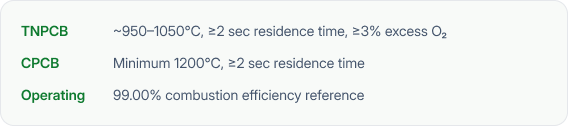
Applicable conditions depend on waste category, equipment design, environmental authorization, and current requirements.
| MATERIAL | CARBON (%) | HYDROGEN (%) | OXYGEN (%) | NITROGEN (%) | SULPHUR (%) | ASH (%) |
|---|---|---|---|---|---|---|
| Food Waste | 48 | 6.4 | 37.6 | 2.6 | 0.4 | 5 |
| Paper | 43.5 | 6 | 44 | 0.3 | 0.2 | 6 |
| Cardboard | 44 | 5.9 | 44.6 | 0.3 | 0.2 | 6 |
| Plastic | 60 | 7.2 | 22.8 | — | — | 10 |
| Textile | 55 | 6.6 | 31.2 | 4.6 | 0.5 | 2.5 |
| Rubber | 78 | 10 | — | 2 | — | 10 |
| Leather | 60 | 8 | 11.6 | 10 | 0.4 | 10 |
| Garden Trimmings | 47.8 | 6 | 38 | 3.4 | 0.3 | 4.5 |
| Wood | 49.5 | 6 | 42.7 | 0.2 | 0.1 | 1 |
| Dirt, Ash, Brick, etc. | 26.3 | 3 | 2 | 0.5 | 0.2 | 68 |
| POLLUTANT | CONTROL APPROACH |
|---|---|
| CO | Controlled combustion, appropriate temperature, turbulence and residence time |
| NOx | Burner selection and control of combustion air and temperature |
| SO₂, HCl & HF | Wet-scrubber treatment |
| Heavy Metals | Adsorbent and wet-scrubber treatment |
| Dioxins & Furans | Secondary combustion, rapid cooling and pollution-control treatment |
| Particulate Matter | Filtration and wet-scrubber systems |
The supplied source material refers to a ceramic filtration plant that can remove more than 98% of particulate matter. Actual performance depends on equipment design, operating conditions, waste characteristics, and maintenance.
Maintain negative pressure inside combustion chambers during loading and burning to protect workers and minimise hot-gas leakage.
Control the size and mass of high-calorific-value waste loads to prevent sudden temperature increases.
Reach the required operating temperature before introducing additional waste.
Waste loading and handling should be carried out under trained and experienced supervision.
Automatic or controlled feeding systems can reduce direct operator exposure to the furnace atmosphere.
The feeding system should be designed to minimise hot flue-gas leakage and prevent backfire.
| FACTOR | WHAT TO CONSIDER |
|---|---|
| Type of Waste | Identify the type and characteristics of waste to be treated. |
| Daily Waste Quantity | Estimate how much waste is generated each day. |
| Moisture Content | Check how much moisture the waste contains, as it affects combustion. |
| Calorific Value | Determine the energy value of the waste to understand combustion requirements. |
| Required Capacity | Select an incinerator capacity that matches your waste volume. |
| Operating Hours | Consider how many hours per day the system will operate. |
| Waste Feeding Method | Choose manual, semi-automatic, or fully automatic feeding based on your requirements. |
| Fuel Type | Select the appropriate fuel and fuel-delivery system for the application. |
| Pollution Control | Consider the required cooling, wet scrubber, and other emission-control systems. |
| Available Space | Check the space required for the incinerator, accessories, stack, and operating area. |
| Maintenance | Consider cleaning, inspection, spare parts, and routine maintenance requirements. |
| Safety Features | Look for temperature controls, emergency systems, pressure control, and other safety provisions. |
| Environmental Requirements | Ensure the system is designed according to applicable environmental requirements and approvals. |
| Installation & After-Sales Support | Consider installation assistance, operator guidance, service, maintenance, and spare-parts support. |
Check the primary chamber, secondary chamber, cooling system, pollution-control equipment, stack, and rated capacity.
Review refractory lining, heat-resistant materials, steel construction, insulation, and other critical components.
Check the wet scrubber, filtration system, cooling system, monitoring equipment, and emission-control configuration.
Evaluate temperature monitoring, emergency shutdown arrangements, pressure control, insulation, and feeding-system safety.
Review manufacturing experience, previous installations, technical capability, and service support.
Check technical specifications, operating manuals, maintenance documentation, warranty, and compliance documentation.
Evaluate installation, commissioning, operator training, spare parts, maintenance, and service availability.
| INCINERATOR STAGE | TNPCB STANDARD | CPCB STANDARD | OPERATING STANDARD |
|---|---|---|---|
| Waste Loading | Maintain negative pressure inside combustion chambers. Control the size and mass of high-calorific waste loads. | Use controlled/automatic feeding where applicable; prevent flue-gas leakage and backfire. | Feed measured quantities at controlled intervals, avoid overloading and maintain a consistent waste mix. |
| Primary Chamber | Maintain around 800°C ± 50°C for initial ignition and solid waste destruction. | Waste combustion at or above 850°C. | Maintain approximately 800°C ± 50°C and monitor temperature continuously. |
| Secondary Chamber | Designed for approximately 950–1050°C, with gas residence time of at least 2 seconds and minimum 3% excess oxygen. | Facilities designed to achieve a minimum 1200°C with gas residence time of at least 2 seconds. | Maintain the required secondary-chamber temperature and residence time according to the applicable operating configuration. |
| Ash Collection | Maintain Total Organic Carbon (TOC) in slag/bottom ash below 3%, or loss on ignition below 5% of dry weight. | Bottom ash should be tested; fly ash should be kept separate from bottom ash. | Remove and manage ash regularly to maintain proper airflow and combustion performance. |
| Water Cooler 1 | Rapidly cool flue gases leaving the secondary chamber to help prevent dioxin and furan formation. | Rapid cooling of hot flue gases before further treatment. | Maintain effective gas cooling before the next treatment stage. |
| Water Cooler 2 | Reduce flue-gas temperature before entering the scrubber. | Reduce gas temperature before entering the scrubber. | Maintain suitable gas temperature for effective wet-scrubber operation. |
| Wet Scrubber | Flue-gas treatment system for pollution control. | Pollution-control stage before final discharge. | Operate the scrubber with the required water circulation and supporting equipment. |
| Stack | Stack height of at least 30 metres above ground level. | Minimum stack height of 30 metres above ground level. | Provide controlled flue-gas discharge through the designated stack. |
Technical Verification Note: Before publishing any figure as a current statutory requirement, guaranteed emission level, or certified performance specification, verify against the latest applicable CPCB/TNPCB requirements, relevant waste-management rules, environmental authorization, and the specific incinerator design.
45+ years of experience in pollution control equipment. Let our experts help you choose the perfect solution for your waste management needs.
45+ Years Experience
300+ Projects Delivered
CPCB & TNPCB Certified
Abdul Kalam Award Winner