A wet scrubber is an advanced air pollution control device used to remove harmful gases, fumes, and dust particles from industrial exhaust streams. It works by spraying a liquid-usually water or a chemical solution-into polluted air, capturing contaminants through absorption and filtration.
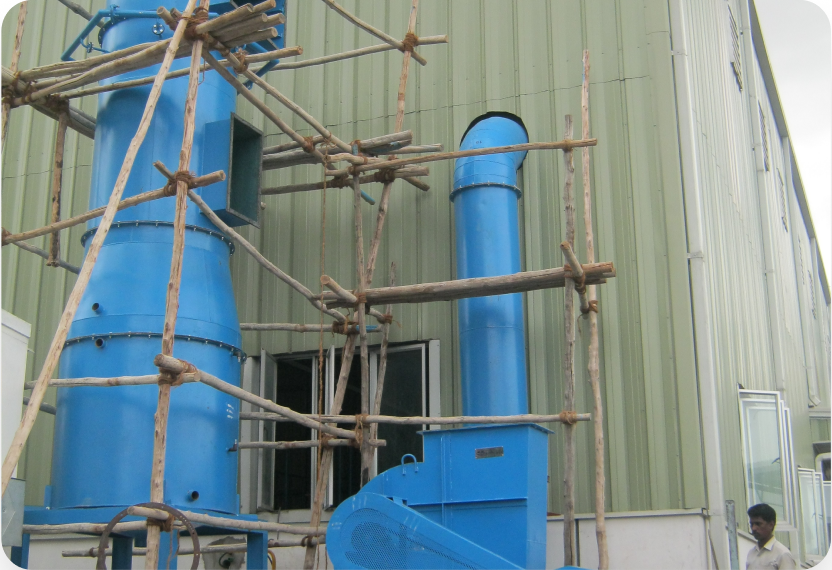
A Wet Scrubber by Deepam Industries is an efficient air pollution control system that removes harmful gases, fumes, dust, and industrial pollutants using water or chemical solutions before releasing clean air.
Built for high efficiency and durability, Deepam wet scrubbers deliver reliable performance in capturing fine particles and gaseous pollutants, helping industries maintain cleaner and safer environments.
Pollution Source / Process Equipment
Fume, Dust & Exhaust Generation
Source Capture Hood / Enclosure
Branch Ducting & Collection Header
Ducting System — Round / Square FRP, PP, MS, SS or suitable material
Isolation & Flow-Control Dampers — L-Type / T-Type / Butterfly / Volume Control
Induced Draft (ID) Fan / Exhaust Fan — Designed for required Airflow & Static Pressure
Wet Scrubber Gas Inlet
Gas–Liquid Contact Zone — Spray Nozzles / Packed Bed / Venturi Section as per application
Scrubbing Liquid Circulation System — Tank → Pump → Spray Header → Nozzles → Recirculation
Pollutant Removal / Absorption — Dust · Acidic Fumes · Alkaline Fumes · Soluble Gases · Aerosols
Gas–Liquid Separation / Mist Eliminator
Scrubber Outlet Duct
ID Fan / Induced Draft System
Stack / Chimney — Adequate Height & Discharge Velocity
Continuous Emission Monitoring System (CEMS)
Treated Gas / Cleaned Air Discharge to Atmosphere
Fresh Water / Scrubbing Chemical
Scrubber Circulation Tank
Circulation Pump
Spray Header & Nozzles
Wet Scrubbing Zone
Recirculation / Blowdown
DP / Pressure Monitoring
pH Monitoring
Pump Status
Temperature Monitoring
Flow Measurement
Liquid Level Monitoring
Fan Status
CEMS / Online Emission Monitoring
Ensures strict pollution control compliance — avoids legal issues, penalties, and shutdown risks
Removes hazardous gases & fine particles effectively — critical for worker and community safety
Prevents environmental damage — reduces air toxicity and long-term ecological impact
Supports continuous plant operation — stable and reliable pollution control system
Cost-effective in the long run — avoids fines, health risks, and operational losses
Protects brand reputation — shows commitment to environmental responsibility and sustainability
Handles large-volume, high-temperature emissions with consistent performance
Improves workplace safety — minimises exposure to harmful fumes and dust
Future-ready solution — meets evolving government and global emission standards
Essential for ESG & sustainability goals — aligns with modern industrial responsibility standards
We collect details about your machine, smoke, gases, temperature, odour, and application.
We review the plant layout, source points, available space, distances, and installation conditions.
Our technical team selects the right suction hood, ducting type, material, size, and airflow requirements.
Based on the application, we determine the suitable wet scrubber, filtration system, materials, pump, nozzles, and dosing system.
We finalise the blower capacity, stack design, height, monitoring point, and maintenance access.
We configure the control panel, water-level indication, pH control, emergency stop, and automation requirements.
Our team reviews all technical specifications, site measurements, pollution requirements, and installation conditions.
Deepam Industries — From Site Assessment to Pollution Control Solution.
50 industries across 5 major sectors — all served by Deepam wet scrubber solutions.
| NO. | HEAVY & CORE INDUSTRIES |
|---|---|
| 1 | Heavy Industries |
| 2 | Steel Industry |
| 3 | Cement Industry |
| 4 | Mining Industry |
| 5 | Sponge Iron Industry |
| 6 | Aluminum Industry |
| 7 | Copper Industry |
| 8 | Zinc Industry |
| 9 | Foundry Industry |
| 10 | Casting Industry |
| 11 | Forging Industry |
| 12 | Steel Rolling Mills |
| NO. | CHEMICAL & PROCESS INDUSTRIES |
|---|---|
| 13 | Chemical Industry |
| 14 | Petrochemical Industry |
| 15 | Fertilizer Industry |
| 16 | Agrochemical Industry |
| 17 | Pesticide Industry |
| 18 | Paint Industry |
| 19 | Dye Industry |
| 20 | Soap & Detergent |
| 21 | Cosmetics Industry |
| 22 | Pharmaceutical Industry |
| NO. | MANUFACTURING & ENGINEERING |
|---|---|
| 23 | Manufacturing Industry |
| 24 | Automotive Industry |
| 25 | Metal Finishing |
| 26 | Electroplating Industry |
| 27 | Galvanizing Industry |
| 28 | Heat Treatment |
| 29 | Boiler Industry |
| 30 | HVAC Industry |
| 31 | LPG Bottling |
| 32 | Gas Processing |
| NO. | TEXTILE & CONSUMER INDUSTRIES |
|---|---|
| 33 | Textile Industry |
| 34 | Garment Industry |
| 35 | Yarn Processing |
| 36 | Spinning Mills |
| 37 | Weaving Mills |
| 38 | Textile Dyeing |
| 39 | Footwear Industry |
| 40 | Leather Industry |
| NO. | ENVIRONMENTAL & UTILITY INDUSTRIES |
|---|---|
| 41 | Environmental Industry |
| 42 | Waste Management |
| 43 | Recycling Industry |
| 44 | Water Treatment |
| 45 | Effluent Treatment |
| 46 | Desalination Plants |
| 47 | Incineration Plants |
| 48 | Hazardous Waste Treatment |
| 49 | Power Plants |
| 50 | Oil Refineries |
High-velocity gas flows through a precision-engineered narrow throat, creating a strong acceleration effect. Finely atomized liquid is injected into the gas stream at high pressure to ensure effective interaction. This generates intense mixing and maximum contact between the gas and liquid phases. Even fine and submicron particles are efficiently captured and removed.
High-velocity gas flows through a precision-engineered narrow throat, creating a strong acceleration effect. Finely atomized liquid is injected into the gas stream at high pressure to ensure effective interaction. This generates intense mixing and maximum contact between the gas and liquid phases. Even fine and submicron particles are efficiently captured and removed.
The gas stream enters the cyclonic scrubber and is forced into a high-speed rotational motion. This spinning action creates strong centrifugal forces within the chamber. As the gas-liquid mixture rotates, heavier particles are thrown outward toward the walls. These particles are then separated and removed efficiently, resulting in cleaner gas discharge
In an ejector venturi scrubber, high-pressure liquid is injected through a nozzle to create a strong jet effect. This liquid jet generates suction, drawing the gas stream into the scrubber without the need for external fans. As the gas mixes with the liquid, intense contact enables efficient particle capture. The cleaned gas is then discharged, ensuring effective pollutant removal.
| No. | Parameter | Details |
|---|---|---|
| 1 | Particulate Matter (PM) | ≤ 50 mg/Nm³ (varies by industry) — indicates dust and solid particles in emissions. |
| 2 | Sulphur Dioxide (SO₂) | Controlled through alkaline scrubbing. Limits vary depending on industry and fuel. |
| 3 | Hydrogen Chloride (HCl) | Typical limit: ≤ 35 mg/Nm³ — common in chemical and incineration industries. |
| 4 | Ammonia (NH₃) | Limit: ≤ 50 mg/Nm³ (approx.) — found in fertilizer and chemical plants. |
| 5 | Chlorine (Cl₂) | Very strict limits due to toxicity — usually maintained at very low ppm levels. |
| 6 | Stack Emission Opacity | Should be minimal — no visible smoke. |

| No. | Norm Type | Details |
|---|---|---|
| 1 | Emission Norms | Limits for pollutants released into air. Includes PM, SO₂, HCl, NH₃, Cl₂. Defined by the Central Pollution Control Board. |
| 2 | Process / Operational Norms | Proper functioning of scrubber system. Includes pH control, Liquid-to-Gas (L/G) ratio, pressure drop, and continuous operation. |
| 3 | Effluent (Wastewater) Norms | Treatment of scrubber liquid discharge. Must meet limits for pH, BOD, COD, TSS. No untreated discharge allowed. |
| 4 | Stack Monitoring Norms | Installation of monitoring systems (CEMS). Regular emission checks. Maintain records and reports. |
| 5 | Safety & Environmental Norms | Safe handling of chemicals. Proper sludge disposal. No leakage or harmful exposure. |
Get expert consultation and comprehensive solutions for your industrial needs